🍏 The apple plantation between the village and the weekend zone
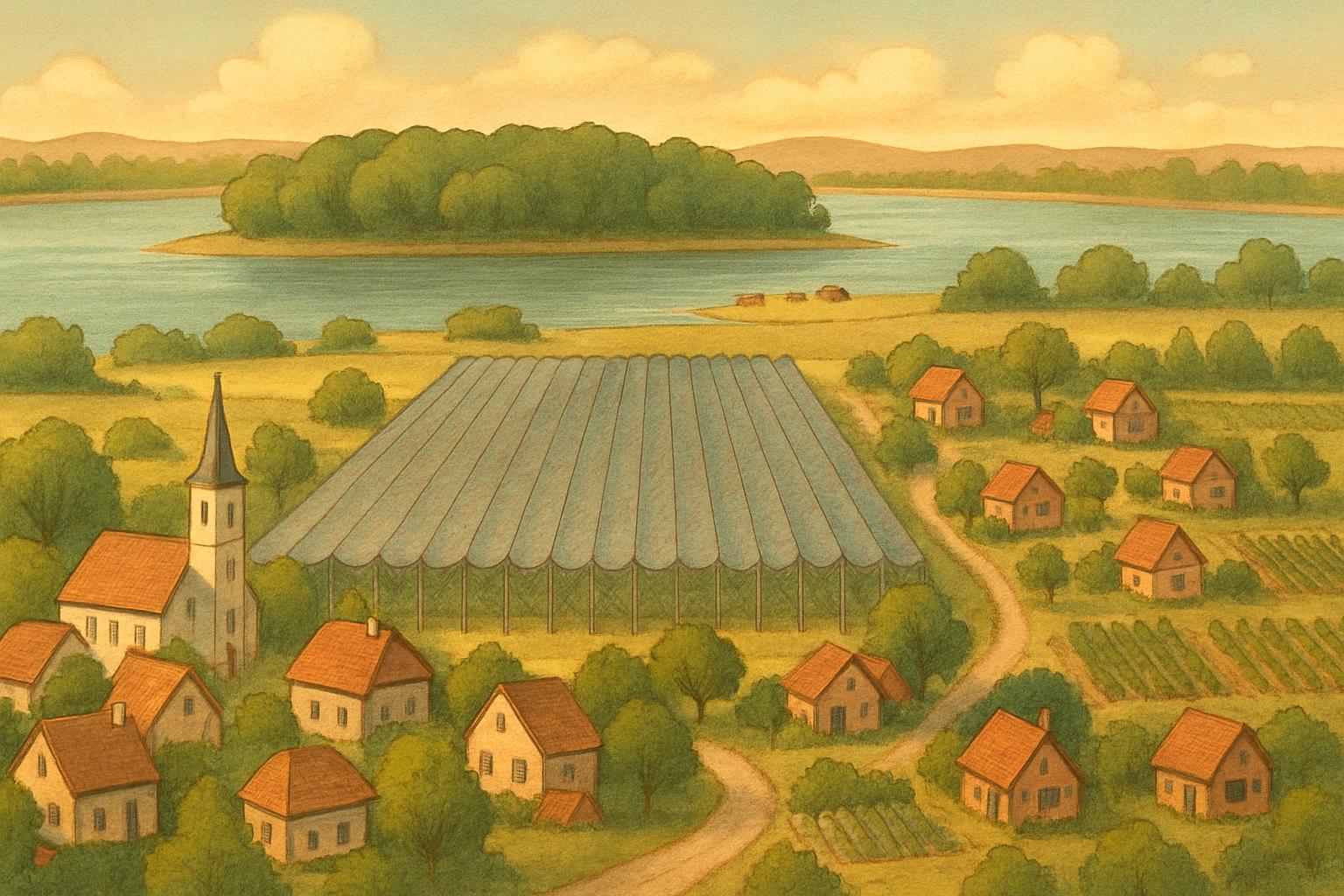
A big apple plantation under hail nets sits between the old village and the weekend zone. Some people treat that line as a border, although both sides live here for the same reasons and deal with the same problems.
If you are coming to Krčedin for the first time, the easiest landmark is the apple plantation. It sits between the old village and the weekend zone, rows perfectly aligned, grey hail nets as far as you can see. On one side, houses where families have lived for generations; on the other, a settlement that started with plots and summer holidays, and where more and more people now stay through the winter too.
A landmark, not a border
The plantation is the largest well-kept orchard in the Krčedin fields: a modern planting under protective netting, with irrigation. From the rise above the village it looks like one big grey field.
In conversation that landmark easily turns into a border. Over garden fences and kafana tables you hear all sorts of things, about the land, the water, about who belongs to whom. We leave that where it started, because most of it cannot be confirmed. A village is entitled to its stories, but they should not be published as facts.
A division that does not hold
It is easy to say: some were born here, others came. It sounds like an explanation, but it is not. That line helps nobody, neither the families here for four generations, nor the people who bought a plot ten years ago and now spend the winter here.
Ask them why they stayed, or why they came, and the answer is mostly the same: the Danube, the island you can see from the bank, the vineyards, and the fact that people here still know who lives next door to whom. Sit down with someone from the weekend zone and with someone from the village and you hear the same sentence twice.
“You hear the same sentence on both sides: I came for the Danube and I stayed.”
The loudest are not the most numerous
If it seems that the village and the weekend zone are at odds, that is because the person who talks the most is heard the furthest. A few people in online groups and two at the bar can make it look like half the village is against the other half. Count them, and that "half" fits into one van.
Most people do not shout. They mend the fence, report a dump, call a neighbour over to help with the firewood.
The same problems on both sides
Illegal dumps are neither a village nor a weekender problem. They appear in ditches, on field tracks and along the edge of the woods, on both sides of the plantation. The same goes for neighbours who play music until three in the morning, cut someone else's tree, or empty a trailer where they should not. There are just as many of them on each side.
The conclusion is simple: whatever gets fixed in Krčedin gets fixed together. A bin in the right place, a report of a dump, a clean-up on the riverbank, an agreement about field roads — none of it asks whose grandfather was born here.
A good next step
- List the worst illegal dumps and publish the list with locations.
- One joint clean-up a year, announced in the village and in the weekend zone alike.
- Clear information on waste collection: when, where, and what is not taken.
- More meeting on neutral ground: Julski dani, the riverbank, the kafana.
The plantation will stay where it is. But it does not have to be a border — it can simply be the clearest signpost on the way to the same Danube.


